
In this article:
Building Belonging in a Virtual Workplace
For organisations with a remote workforce, building a sense of belonging takes more than giving people the right technology to work from home. When teams are spread across locations, countries and time zones, connection does not happen by accident. It has to be created intentionally.
This is particularly relevant to the BPO and outsourcing industry. A Talent may spend most of their working day focused on a specific client, project or contact centre operation. The work itself depends on strong communication and collaboration, but those interactions can become almost entirely task-focused. Over time, that can leave people connected to their work without feeling equally connected to the wider organisation.
Why belonging matters when working from home
Working from home offers flexibility, autonomy and access to opportunities regardless of location. It also changes the way people build relationships at work.
A recent study published in Frontiers in Psychology examined data from 7,601 people and 15,202 observations collected through the UK Household Longitudinal Study between 2021 and 2024. The researchers found that greater frequency of remote working was associated with greater loneliness. However, they also found an important difference in how people used social media: active social media use, such as posting and interacting with others, weakened the association between remote working and loneliness, while passive use such as scrolling did not.
The distinction is particularly interesting for organisations with a fully remote workforce. Simply giving people another digital platform does not necessarily create connection. The value comes from creating opportunities for people to participate, share and interact with one another.
That is the difference between providing communication tools and building a virtual community.
A virtual workplace needs more than communication
Modern BPO operations already depend heavily on digital communication. Client platforms, messaging tools, video calls, knowledge bases and workforce management systems allow distributed teams to operate effectively from almost anywhere.
But communication is not the same as community.
A message telling someone about a process change fulfils a communication need. A conversation about a shared interest, a photograph from someone's weekend or a virtual event where people can meet colleagues outside their immediate project fulfils a different one.
This matters because people do not stop being social simply because they start working from home.
Research published in the International Journal of Organizational Analysis examined 137,487 knowledge workers across 88 countries and looked specifically at people's satisfaction with their connection to colleagues while working from home. Around 42% of participants reported being satisfied with their connection to colleagues. The data was collected between April 2020 and March 2021, when working from home was the only option for many people, so it should not be treated as a measure of today's remote workforce. However, the scale and global reach of the study demonstrate how significant connection became as organisations moved away from traditional workplaces.
For organisations that have chosen remote working as a long-term model rather than a temporary response, the lesson is clear: connection needs to be part of the operating model.
Make belonging intentional
One of the clearest examples comes from GitLab, which has operated as an all-remote organisation since its earliest days.
In an article published by Harvard Business Review, GitLab CEO Sid Sijbrandij describes how the company developed systems and processes around a distributed workforce. GitLab began as a distributed organisation because its founders and early employees were based in different countries, rather than as a later response to the pandemic.
GitLab also publishes detailed guidance on informal communication in an all-remote environment. Its approach includes coffee chats, social calls, group activities and other opportunities for people to talk about subjects unrelated to their usual work. GitLab explicitly argues that all-remote organisations should be intentional about informal communication rather than expecting it to happen naturally.
That is an important distinction.
In a physical workplace, informal connection can happen almost without anyone planning it. People meet in corridors, talk while making coffee, discover shared interests or get to know someone from another department by chance.
A remote workplace removes many of those accidental interactions.
That does not mean they cannot happen. It means organisations need to create different opportunities for them.
Building an online community
A successful virtual community should give people reasons to participate that go beyond their immediate responsibilities.
That could mean a place to share photographs, discuss hobbies, celebrate achievements, recommend books or films, take part in competitions or simply have a conversation that has nothing to do with work.
For a BPO organisation, this can be particularly valuable because project structures can naturally create separate groups. A Talent working on one client account may have very little reason to interact with someone working on another.
A wider community provides opportunities to build those connections.
It can also give people the chance to contribute rather than simply consume information. Hosting a discussion, sharing a skill, organising a competition or leading a virtual event allows people to shape the community themselves.
That distinction is supported by the 2026 Frontiers in Psychology research, which found that active social media use was associated with a weaker relationship between remote working and loneliness, while passive use showed no significant moderating effect. In other words, there is a difference between giving people somewhere to scroll and giving them somewhere to participate.
What belonging can look like in a remote organisation
Building belonging in a remote organisation does not require constant social activity or an endless stream of virtual meetings. It is about creating a range of opportunities for people to connect in ways that feel natural to them.
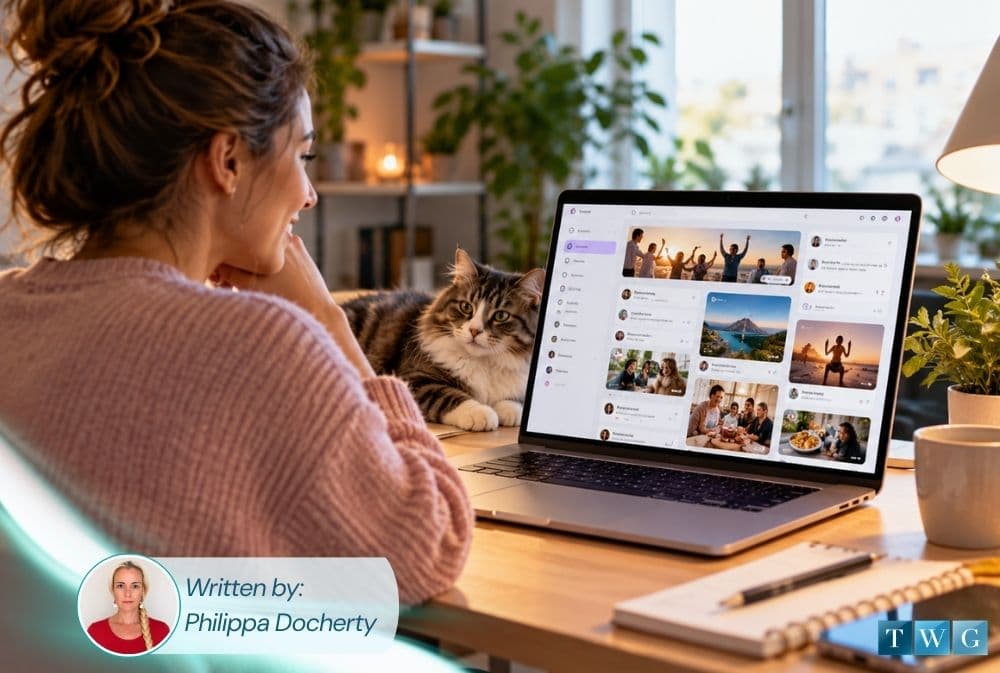
For some, that might mean an internal social platform where people can share interests, photographs, achievements and ideas. For others, it could be virtual events, informal discussions, shared hobbies, competitions or opportunities to learn from colleagues outside their immediate team. The important thing is that people have spaces where they can interact as individuals, rather than only as part of a project or function.
This is something we put into practice at TWG through our online community and daily virtual events, giving Talents and Seniors opportunities to share interests, knowledge and experiences beyond their day-to-day work. The aim is not to make everyone participate in everything, but to create enough opportunities for people to find connections that feel natural to them and to feel part of something beyond the project they happen to be working on.
Belonging is built over time
There is no single platform, event or initiative that creates belonging. It develops through repeated experiences.
People need opportunities to be recognised. They need spaces where they can contribute. They need ways to discover shared interests and build relationships. Most importantly, they need to feel that the community belongs to them rather than being something imposed on them by the organisation.
For BPO and outsourcing businesses, this is an important part of building a sustainable remote workforce. The technology that makes working from home possible is only one part of the equation.
The other part is human.
A virtual workplace should not simply try to recreate the physical office online. It should create its own ways for people to connect, collaborate and build relationships.
Because working from home does not have to mean working alone. With intentional communication, active participation and meaningful opportunities to connect, a remote workforce can still feel like part of something much bigger.
About the Author
Philippa is a Community Manager at TWG, where she has been part of the team for 4.5 years. A branding specialist with a professional background in marketing, graphic design and project management, she brings extensive experience in communications, content and creative development.
Based in the Canary Islands with her husband & three rescue cats, she enjoys travelling & discovering new destinations.
Share this article


Stay in the know
Discover more articles, explore emerging trends, and stay connected with the future of remote work, global recruitment, and business process outsourcing by staying informed with the latest industry news, expert perspectives, and insights from TalentWorldGroup.